


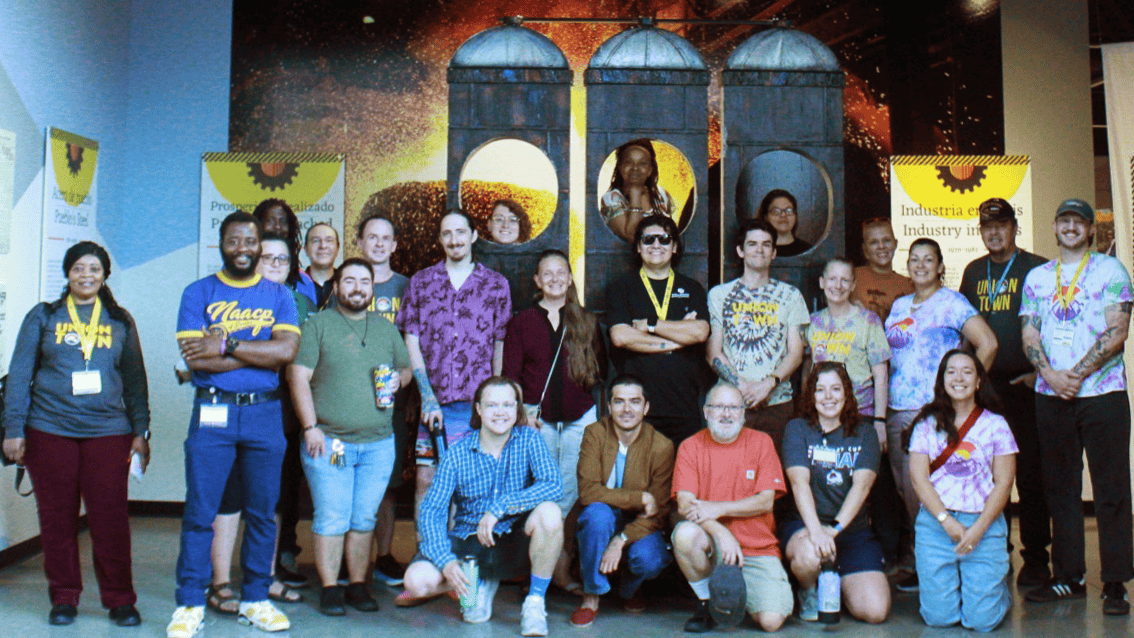
2026 Legislative Session Wrap-Up


Colorado’s 120-day legislative session wrapped on May 13 with Joint Budget Committee members talking about tears shed and sleep lost because of the cuts they had to make, blaming a $1.5 billion shortfall on revenue restrictions caused by TABOR, and spending cuts and tax cuts for the rich and corporations in the federal budget bill HR-1.
Joint Budget Committee Vice Chair Jeff Bridges, speaking at our statewide member meetings in May, described this as “an extraordinarily painful budget.”
“This is a budget that kept me up at night. Every member of the budget committee at some point over this past year broke down in tears,” he said. “We were forced to cut benefits for kids with disabilities on Medicaid.”
Bridges told us that having to cut Cost of Living Increases broke his heart, but emphasized that the Committee stood up and fought for state employees and ensured the Governor’s office was working closely with COWINS leadership to ensure we held on to what was most important to state workers.
“We did manage to ensure–and over the objections of various members of the budget committee–that no-one working for the state will see a decrease in their take-home pay, despite some pretty significant increases in the cost of healthcare which we see every single year, and despite all sorts of challenges.”
Thanks to hundreds of members who turned out for Lobby Day and sent emails to legislators, members who testified before the JBC, and a lot of long hours of back and forth over legislation, we managed to stop any decreases to take-home pay.
Despite that hard work, the Long Bill, HB26-1410, stripped funding for this year’s Cost of Living Adjustments–this would have cost the General Fund $65 million.
We did win the fight to keep full funding for Step Pay–worth about $10 million–in the bill. This win means we protected the number one priority every time we bargain–Step Pay–which ensures all state employees can count on moving up through the pay range for their position.
We also secured a 1.0% increase in the pay ranges: this means employees at the bottom of the pay scale will receive a 1.0% raise, and those eligible for a step increase will see a slightly higher one.
Importantly, our Steps 2.0 Workgroup, established under Article 31.2 of the Partnership Agreement, has been working to improve our Step Raise system: we’ll be sharing news about this soon!
Even though we weren’t able to hold on to our COLAs, we believe that powerful testimony from Brad Bruce, one of our non-classified members from the Office of Information Technology, helped drive home a message around staff retention and rising costs that helped us preserve our Step Raises.

Bruce talked about how critical pay is to staff morale and retention, “especially now, as we see public sector workers under attack across the country. We are grappling with the current statewide vacancy rate and the results of the hiring freeze implemented last year.”
“Being able to count on our pay increase is especially important now due to the rising cost of living, especially for housing and food,” he told committee members.
We lobbied hard to preserve the 100% coverage of Health, Life and Dental premium increases for this upcoming year. Despite skyrocketing healthcare costs across the country, state employees do not need to worry about their premiums increasing and eating into their take home pay.
That’s a significant savings for state employees and helps keep cash in our pockets.
Union Steward Rebeca Vidaurri, a nurse who had worked with the state for 23 years, helped secure that win by testifying before the JBC.
“Every dollar counts for state workers, especially now, as we see prices skyrocket on everything from groceries to gas, and knowing we can count on our HLD premiums to be the one stable thing makes it easier to plan ahead, and gives us a lot of peace of mind,” she told committee members. “It also means that thousands of state workers like me can continue to stick with the state: to work where we want to work, in public service.”
The Long Bill also protected funding for the Human Resources Information Systems (HRIS), but cut funding for our housing pilot program (worth $1.7 million). And, while it preserved the $300,000 tuition reimbursement fund, it did not fund the $95,000 expansion we negotiated for this fiscal year.
As the budget dust settled in the final days and hours of session, we managed to fight for and win a bill squeezing $1.8 million out of a bad budget to increase minimum wage for state employees.
Hundreds of you answered the urgent call for emails and calls to legislators, and that hard work paid off–they listened to our members and passed SB26-193 on the last day of session.
The bill reinforces the power of our union and collective bargaining by clarifying that local municipalities cannot impose minimum wage rates on state employees because of our right to bargain state employee wages.
And a Memorandum of Understanding with the Governor allocates funding to raise wages for the workers who need it most. Your co-workers earning minimum wage will see an increase from $16.55 to $19.29 an hour, starting on November 1. And, because the MOU addresses compression, anyone earning less than $24 an hour will see modest, corresponding increases.
Now we’re working closely with higher education leaders to advocate so that our non-classified and de-classified coworkers across higher education–who don’t have or have lost the protections afforded by our Partnership Agreement–see the same increases.

We secured a win by getting HB26-1413 passed and removing the sick pay cap for state employees. Unlike any of our other paid time off, sick leave has always been statutorily capped at ten days a year. This bill lifts that cap, meaning that for the first time ever we will be able to negotiate for better sick leave accruals in our next Partnership Agreement.
The bill will also increase military leave from three to four weeks a year for public servants who are also members of the National Guard Reserve.

Legislators spent a lot of time on Corrections this session trying to direct very limited funding in ways that might help fix DOC. And our member leaders were there throughout the session, testifying repeatedly about the staffing retention crisis and its impact on safety and well being for corrections workers, the incarcerated population, and our communities.
As union steward and DOC case manager Kara Brown said in testimony before the JBC, “the reality is that DOC is holding many people beyond their parole eligibility, not because they pose a public safety risk, but because we lack the staffing and systems we need to successfully release them.”
Brown urged the JBC to support our call to put a formal structure in place that puts DOC workers’ voices front and center, and to find a way to allocate sufficient funding to support efforts to fix the staffing retention crisis.
All of that hard work paid off with a couple of positive wins, but couldn’t fix the budget crisis, or mismanagement in DOC.
A critical win for DOC, we fought for and won $10 million to fund a shift relief factor increase from 1.6 to 1.8 for Correctional Officers for the East Cañon Prison Complex. The goal is to allow additional full-time hires, and is a test pilot to prove that addressing chronic understaffing will lead to better outcomes.
Our biggest fight was around DOC’s push to expand prison capacity through Supplemental Bill HB26-1151.
We initially opposed DOC’s request to fund 788 new state prison beds because it did nothing to address systemic problems. This was the first time we’ve ever opposed this kind of request, but we felt we had no choice but to highlight the fact that increasing capacity didn’t make sense while DOC’s staffing crisis is putting our members, the incarcerated population, and the public at risk.
Union stewards Abraham Medina and Dana Mueller both testified before the DOC Smart Hearings on this funding request, driving home the dangerous reality of chronic understaffing.
“I want to emphasize that as Union Stewards, our primary concern is ensuring every officer who walks into that facility returns home safely at the end of their shift, said Medina. “But DOC’s staffing crisis has reached a tipping point, and is compromising safety for both staff and the incarcerated population.”
Dana Mueller also urged legislators to realize how serious the crisis is.

The JBC initially denied DOC’s request, and withheld 50% of requested jail backlog and medical cost funding, citing a lack of a plan by DOC to address the staffing shortages, parole bottlenecks, and population management failures.
Then on January 20 the JBC reversed course, passing HB26-1151 and approving the funding.
JBC Vice-Chair Jeff Bridges wrote to Governor Polis to emphasize that “emergency appropriations cannot become a substitute for operational accountability,” and urging DOC to collaborate with COWINS “to address the serious operational and safety challenges associated with the rising prison population pressures”
COWINS united with our ally the Colorado Criminal Justice Reform Coalition to call for the creation of a formal Working Group that would bring key stakeholders together to address the long term operational and staffing crisis plaguing DOC.
We lobbied hard for SB26-159, the bill that would create a workgroup that could develop a more comprehensive plan to fix DOC’s capacity crisis. COWINS steward, DOC bargaining team member Michael Resendez testified before the committee discussing the proposal.

“That plan must be informed by those most affected: the incarcerated population, inmate families, community stakeholders, and, most importantly, the workers who make DOC run,” he said. “DOC workers must be in this workgroup, because we know best what doesn’t work, what solutions will work and how to implement them.”
In the end that bill passed, and does stipulate that the workgroup will include one DOC employee. Our fight now will be to ensure that the workgroup actually moves a good plan forward.
We also lobbied hard alongside our community ally, the Colorado Criminal Justice Reform Coalition, for SB26-036, a bill that tries to mitigate overcrowding by strengthening the Prison Population Measures Act.
COWINS steward and DOC bargaining team member Devon Lee testified in support of this bill.

“Passing this bill would help bring more transparency and more accountability to what DOC is doing to reduce the incarcerated population, and create more safe pathways for eligible individuals to be released,” he said, and reminded committee members that “the goal of Corrections is rehabilitation, not to lock people up and throw away the key.”
In the end, the bill passed, raising the vacancy rate trigger from three to four percent and ensuring that once activated, the Department of Corrections must follow the PPMM until the vacancy rate exceeds five percent for 30 consecutive days. The PPMM includes:
Article 32.9 of the Partnership Agreement had established a workgroup to develop pilot programs meant to address housing availability and affordability issues facing state employees. We did that work to have a program ready to go this year, but the funding for implementation this year–worth $1.7M–was cut, delaying the start of this program.
At the same time, we did secure a win that will provide some support for members living in high-cost housing areas of the state, lifting income eligibility caps for workers in post certified positions including dispatchers, correctional officers, port of entry officers and wildlife officers to receive mortgage assistance from the Colorado Housing and Finance Authority (CHFA). This is a win, especially for those in remote areas, where affordable housing availability and options are limited.
COWINS united with community allies to defeat SB26-180, a bill that would have allowed state enterprises to opt into an investment performance authority (IPA) to invest their funds in higher yield investments. Right now, state enterprises like FAMLI invest their funds in risk free Treasury bonds. IPAs depend on the market, adding financial risk.
Addressing child care needs should not come at the expense of a solvent, voter-approved program. The bill would have essentially permitted a raid of the FAMLI Cash fund enterprise to fund childcare, and would have set a dangerous precedent for funds that are essential to maintaining benefits and program stability.
State legislators have once again passed the Worker Protection Act, a bill that would update the state’s 80-year-old Labor Peace Act to eliminate a unique-to-Colorado requirement for a second election for private sector workers trying to unionize. Sadly, it’s anticipated that Governor Polis will, for the second year in a row, veto the bill. We stand in solidarity with the rights of ALL workers trying to unionize.
In a stunning setback for worker protections, SB26-121 passed, lifting the overtime threshold for agricultural workers from 48 hours during off-peak seasons to 56 hours year round. We lobbied hard against this bill because it made farmworkers the only Coloradans who need to work more than 40 hours to receive overtime pay. Like the Worker Protection Act above, this bill doesn’t impact state workers directly, but we stood up against eroding overtime protections and will keep fighting against this disappointing regression.
We are all disappointed that we couldn’t hold on to our cost of living increases, especially now, while prices are skyrocketing.
But we can also be proud of the hard fight we waged to stop us from moving backwards, and in some cases, to help us move forward.
The last time Colorado faced a $1.5 billion deficit was in the 2009/2010 fiscal year: that brought a 9% cut to state spending, $263 million in budget cuts, losing 270 full-time equivalent positions, and forced furloughs, or unpaid time off, which amounted to a 5% pay cut for everyone.
That was before we had collective bargaining rights, a strong union, and a great Partnership Agreement.

One way to do that is getting a Graduated Income Tax this November, which would start to fix our tax code by replacing the current 4.4% flat tax with higher rates for the rich. The top 3%–those earning $500,000 or more–would pay more taxes, and the rest of us would see lower taxes. That would generate about $2 billion in revenues to help pay for schools, healthcare, and child care, and mean more left over in the budget to fund our contract and fix state services.
Starting this weekend, COWINS members are meeting up with union and community allies to canvass in support of the candidates we’ve endorsed in the June primaries.

You have until May 31 to help elect a fellow state worker to the PERA board. Luke Stanley is a union steward at Colorado School of Mines, the COWINS District 4 Chair for JeffCo. He believes state workers like us who pay into this system deserve a stronger voice, clearer answers, and better results.
In addition to mail-in ballots, PERA members can cast your vote using the online secure account and the PERA mobile app.
Finally, let’s all remember the biggest takeaway from this legislative session: it’s our members that made it possible to stand our ground in one of the toughest budget fights ever.
These members are our union, and they are fighting for you by joining Lobby Day, by emailing and calling our elected representatives, by testifying, and by being active on our committees.
If you aren’t already a member, you can be a part of it too by signing up now, and adding your voice to the work that impacts your life every single day.
A narrative of the 2026 wins and updates we have from the legislative session.
Colorado WINS © 2007-2026. All Rights Reserved. Accessibility | Cookie Policy | Disclaimer | Privacy Policy | Terms of Service